$2.00Original price was: $2.00.$1.00Current price is: $1.00.
Alfred Bernhard Nobel (/noʊˈbɛl/noh-BEL;[1]Swedish:[ˈǎlfrɛdnʊˈbɛlː]ⓘ; 21 October 1833 – 10 December 1896) was a Swedish chemist, inventor, engineer, and businessman. He is known for inventing dynamite, as well as having bequeathed his fortune to establish the Nobel Prizes.[2] He also made several other important contributions to science, holding 355 patents during his life.
Born into the prominent Nobel family in Stockholm, Nobel displayed an early aptitude for science and learning, particularly in chemistry and languages; he became fluent in six languages and filed his first patent at the age of 24. He embarked on many business ventures with his family, most notably owning the company Bofors, which was an iron and steel producer that he had developed into a major manufacturer of cannons and other armaments. Nobel’s most famous invention, dynamite, was an explosive made using nitroglycerin, which was patented in 1867. He further invented gelignite in 1875 and ballistite in 1887.
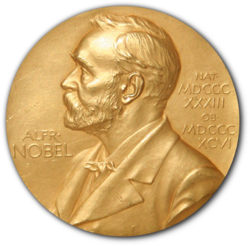
Upon his death, Nobel donated his fortune to a foundation to fund the Nobel Prizes, which annually recognize those who have “conferred the greatest benefit to humankind”.[3][4] The synthetic element nobelium was named after him,[5] and his name and legacy also survive in companies such as Dynamit Nobel and AkzoNobel, which descend from mergers with companies he founded. Nobel was elected a member of the Royal Swedish Academy of Sciences, which, pursuant to his will, is responsible for choosing the Nobel laureates in Physics and in Chemistry.
The birthplace of Alfred Nobel at Norrlandsgatan in Stockholm
Alfred Nobel was born in Stockholm, Sweden, on 21 October 1833. He was the third son of Immanuel Nobel (1801–1872), an inventor and engineer, and Andriette Nobel (née Ahlsell 1805–1889).[6][7] The couple married in 1827 and had eight children. The family was impoverished, and only Alfred and his three brothers survived beyond their childhood.[6] Through his father, Alfred Nobel was a descendant of the Swedish scientist Olaus Rudbeck (1630–1702).[8] Nobel’s father was an alumnus of the Royal Institute of Technology in Stockholm and was an engineer and inventor who built bridges and buildings and experimented with different ways of blasting rocks. He encouraged and taught Nobel from a young age.[7]
Alfred Nobel at a young age in the 1850s
Following various business failures caused by the loss of some barges of building material, Immanuel Nobel was forced into bankruptcy. Nobel’s father moved to Saint Petersburg, then part of the Russian Empire, and grew successful there as a manufacturer of machine tools and explosives.[9] He invented the veneer lathe, which made possible the production of modern plywood,[10] and started work on the naval mine.[11] In 1842, the family joined him in the city.[12] Now prosperous, his parents were able to send Nobel to private tutors, and the boy excelled in his studies, particularly in chemistry and languages, achieving fluency in English, French, German, and Russian.[6] For 18 months, from 1841 to 1842, Nobel attended the Jacobs Apologistic School in Stockholm, his only schooling; he never attended university.[13][14]
Nobel gained proficiency in Swedish, French, Russian, English, German, and Italian. He also developed sufficient literary skill to write poetry in English. His Nemesis is a prose tragedy in four acts about the Italian noblewoman Beatrice Cenci. It was printed while he was dying, but the entire stock was destroyed immediately after his death, except for three copies, being regarded as scandalous and blasphemous. It was published in Sweden in 2003 and has been translated into Slovenian, French, Italian, and Spanish.[15]
Scientific career
Portrait of Nobel by Gösta Florman (1831–1900)
As a young man, Nobel studied with chemist Nikolai Zinin; then, in 1850, he went to Paris to further the work. There he met Ascanio Sobrero, who had synthesized nitroglycerin three years before. Sobrero strongly opposed the use of nitroglycerin because it was unpredictable, exploding when subjected to variable heat or pressure. But Nobel became interested in finding a way to control and use nitroglycerin as a commercially usable explosive; it had much more power than gunpowder. In 1851 at age 18, he went to the United States for one year to study,[16] working for a short period under Swedish-American inventor John Ericsson, who designed the American Civil War ironclad, USS Monitor. Nobel filed his first patent, an English patent for a gas meter, in 1857, while his first Swedish patent, which he received in 1863, was on “ways to prepare gunpowder”.[17][18][6] The family factory produced armaments for the Crimean War (1853–1856), but had difficulty switching back to regular domestic production when the fighting ended and they filed for bankruptcy.[6] In 1859, Nobel’s father left his factory in the care of the second son, Ludvig Nobel (1831–1888), who greatly improved the business. Nobel and his parents returned to Sweden from Russia, and Nobel devoted himself to the study of explosives, and especially to the safe manufacture and use of nitroglycerin. Nobel invented a detonator in 1863, and in 1865 designed the blasting cap.[6]
On 3 September 1864, a shed used for preparation of nitroglycerin exploded at the factory in Heleneborg, Stockholm, Sweden, killing five people, including Nobel’s younger brother Emil.[19] He was then deprived of his license to produce explosives.[20] Fazed by the accident, Nobel founded the company Nitroglycerin AB in Vinterviken so that he could continue to work in a more isolated area.[21] Nobel invented dynamite in 1867, a substance easier and safer to handle than the more unstable nitroglycerin. Dynamite was patented in the US and the UK and was used extensively in mining and the building of transport networks internationally.[6] In 1875, Nobel invented gelignite, more stable and powerful than dynamite, and in 1887, patented ballistite, a predecessor of cordite.[6]
Nobel was elected a member of the Royal Swedish Academy of Sciences in 1884, the same institution that would later select laureates for two of the Nobel prizes, and he received an honorary doctorate from Uppsala University in 1893. Nobel’s brothers Ludvig and Robert founded the oil company Branobel and became hugely rich in their own right. Nobel invested in these and amassed great wealth through the development of these new oil regions. It operated mainly in Baku, Azerbaijan, but also in Cheleken, Turkmenistan. During his life, Nobel was issued 355 patents internationally, and by his death, his business had established more than 90 explosives and armament factories, despite his apparently pacifist character.[6][22]
Nobel found that when nitroglycerin was incorporated in an absorbent inert substance like kieselguhr (diatomaceous earth) it became safer and more convenient to handle, and this mixture he patented in 1867 as “dynamite”.[6] Nobel demonstrated his explosive for the first time that year, at a quarry in Redhill, Surrey, England. To help reestablish his name and improve the image of his business from the earlier controversies associated with dangerous explosives, Nobel had also considered naming the highly powerful substance “Nobel’s Safety Powder”, which is the text used in his patent, but settled with Dynamite instead, referring to the Greek word for “power” (δύναμις).[23][6][24]
Nobel later combined nitroglycerin with various nitrocellulose compounds, similar to collodion, but settled on a more efficient recipe combining another nitrate explosive, and obtained a transparent, jelly-like substance, which was a more powerful explosive than dynamite. Gelignite, or blasting gelatin, as it was named, was patented in 1876; and was followed by a host of similar combinations, modified by the addition of potassium nitrate and various other substances.[6] Gelignite was more stable, powerful, transportable and conveniently formed to fit into bored holes, like those used in drilling and mining, than the previously used compounds. It was adopted as the standard technology for mining in the “Age of Engineering”, bringing Nobel a great amount of financial success, though at a cost to his health. An offshoot of this research resulted in Nobel’s invention of ballistite, the precursor of many modern smokeless powder explosives and still used as a rocket propellant.[25]
There is a well-known story about the origin of the Nobel Prize, although historians have been unable to verify it, and some dismiss the story as a myth.[26] In 1888, the death of his brother Ludvig supposedly caused several newspapers to publish obituaries of Alfred in error. One French newspaper condemned him for his invention of military explosives—in many versions of the story, dynamite is quoted, although this was mainly used for civilian applications—and this is said to have brought about his decision to leave a better legacy after his death.[6] The obituary stated, Le marchand de la mort est mort (“The merchant of death is dead”),[6] and went on to say, “Dr. Alfred Nobel, who became rich by finding ways to kill more people faster than ever before, died yesterday.”[27] Nobel read the obituary and was appalled at the idea that he would be remembered in this way. His decision to posthumously donate the majority of his wealth to found the Nobel Prize has been credited to him wanting to leave behind a better legacy.[28][6] However, it has been questioned whether or not the obituary in question actually existed.[28]








Reviews
There are no reviews yet.