Haley has two brothers and a sister.[35] She attended Orangeburg Preparatory Schools, graduating in 1989.[36] She graduated from Clemson University in 1994 with a B.S. degree in accounting and finance.[37][38][39] Haley has been known by her middle name, Nikki, a Punjabi name meaning “little one”, since she was born.[40]
Early career
After graduating from college, Haley worked for FCR Corporation, a waste management and recycling company, before joining her family’s clothing business as its bookkeeper[41] and chief financial officer.[42] After she married Michael Haley in 1996,[43] she became active in civic affairs. In 1998, she was named to the board of directors of the Orangeburg County Chamber of Commerce. She was named to the board of directors of the LexingtonChamber of Commerce in 2003. Haley became treasurer of the National Association of Women Business Owners in 2003, and president in 2004.[44]
Haley chaired the Lexington Gala to raise funds for a local hospital.[45] She also served on the Lexington Medical Foundation, Lexington County Sheriff’s Foundation, and West Metro Republican Women.[46] She was the president of the South Carolina Chapter of the National Association of Women Business Owners, and was chair for the 2006 Friends of Scouting Leadership Division campaign.[47]
South Carolina House of Representatives (2005–2011)
Campaigns
In 2004, Haley ran for the South Carolina House of Representatives to represent District 87 in Lexington County. She ran in the Republican primary on a platform of education reform and property tax relief.[48][49] Initially, she ran because she believed that incumbent Republican state representative Larry Koon, who was the longest-serving legislator in the South Carolina Statehouse at the time, was not going to seek reelection, but Koon entered the race just before the filing deadline.[50]
In the primary election, Koon received 42 percent of the vote, Haley received 40 percent, and David Perry received 17 percent.[51] As no candidate received a majority of the vote (50 percent or higher), Haley and Koon advanced to a runoff election on June 22.[52] In the runoff, she defeated Koon 55 percent to 45 percent.[53] After his loss, Koon accused Haley of running a smear campaign, which she denied.[54] She ran unopposed in the general election.[55]
Haley became the first Indian-American to hold office in South Carolina.[56] She was unopposed for re-election to a second term in 2006.[57] In 2008, she won re-election with 83 percent of the vote, defeating Democrat Edgar Gomez, who garnered only 17 percent.[58][59]
One of Haley’s stated goals was to lower taxes. She voted against a proposed cigarette surtax three times.[62] She voted for a bill that raised sales taxes from five cents per dollar to six cents per dollar, exempted sales tax on unprepared food such as canned goods, and exempted property tax on “owner-occupied residential property” except for the taxes due from what is still owed on the property.[63] Haley was named a “Taxpayer Hero” by Governor Mark Sanford in 2005 and a “Friend of the Taxpayer” by the South Carolina Association of Taxpayers in 2009.[64]
Haley implemented a plan in which teachers’ salaries would be based on not only seniority and qualifications but also job performance, as determined by evaluations and reports from principals, students, and parents.[65] She supports school choice and charter schools.[66] Haley also supports barring legislators from collecting legislative pensions while in office. She believes such pensions should be based on only the $10,400 legislative salary instead of the salary plus lawmakers’ $12,000 annual expense allowance.[67]
Haley has stated that, as a daughter of immigrants, she believes the immigration laws should be enforced.[68] She voted in favor of a law that requires employers to be able to prove that newly hired employees are legal residents of the United States, and also requires all immigrants to carry documentation at all times proving that they are legally in the United States.
Haley describes herself as pro-life and has supported legislation to restrict abortion.[69][70][71] She has stated “I’m not pro-life because the Republican Party tells me. I’m pro-life because all of us have had experiences of what it means to have one of these special little ones in our life.”[71] In 2009, she co-sponsored a bill that would mandate a 24-hour waiting period for women seeking abortions after an ultrasound, also known as the “reflecting” period.[72] The bill passed both legislative chambers in 2010 and was signed into law by Governor Sanford later that year.[73]
In 2016, as governor, Haley re-signed a new state law that bans abortions at 20 weeks of pregnancy.[71] She has voted in favor of some abortion-related bills that were tabled or rejected, including the Inclusion of Unborn Child/Fetus in Definition for Civil Suits Amendment, Prohibiting Employment Termination Due to Abortion Waiting Period amendment, and Exempting Cases of Rape from Abortion Waiting Period amendment. The latter would have allowed women not to have to wait 24 hours before having an abortion in some cases.[74]
As a state legislator, Haley served on the Committee on Labor, Commerce and Industry[75] and the Committee on Medical, Military, Public and Municipal Affairs.[75] She had several caucus memberships, including the Freshman Caucus in 2005–06 (chair), the Sportsman’s Caucus, and the Women’s Caucus in 2007 (vice chair).[76] She also served on the Lexington County Meth Taskforce.
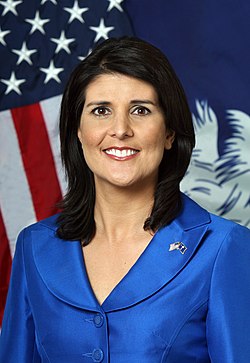
Haley’s gubernatorial portraits during her first (left) and second (right) term
On May 14, 2009, Haley announced that she would run for the Republican nomination for governor of South Carolina in the 2010 election.[77] Haley had been persuaded to run by incumbent governor and fellow Republican Mark Sanford.[78] She was endorsed by former Massachusetts Governor Mitt Romney, as well as Jenny Sanford, the first lady of South Carolina.[79][80] Haley also received the endorsement of former Alaska Governor Sarah Palin three weeks before the primary. When she received Palin’s endorsement, Haley was trailing three other candidates in the polls.[81]
The Republican gubernatorial primary took place on June 8, 2010, and Haley received 49% of the vote, forcing a runoff election on June 22.[82] Haley won the runoff vote 65 to 35 percent.[83] According to ABC News, “pundits credited the notable endorsements of tea party groups, former state first lady Jenny Sanford, and former Alaska Gov. Sarah Palin with legitimizing her candidacy in the face of the state’s male-dominated political establishment”.[84]
On August 12, 2013, Haley announced she would seek a second term as governor.[87] She faced a challenge in the Republican primary from Tom Ervin, who later withdrew and reentered the race as an independent.[88][89] As in 2010, Vincent Sheheen of the Democratic Party ran against Haley. Libertarian Steve French and United Citizens Party candidate Morgan Bruce Reeves also ran.[89] The five candidates debated twice.[90][91] A week after the second debate, Ervin withdrew from the race and endorsed Sheheen.[92]
Haley was reelected on November 4, 2014, defeating Sheheen, 55.9% to 41.3%.[93]
Tenure
Haley took office as governor in January 2011. In 2012, former governor Mitt Romney considered her for his vice-presidential running mate.[69] Haley said that she would turn down any potential vice presidential offer.[94]
In June 2011, Haley signed an “Arizona-style” immigration law.[95] Much of the act was blocked by the federal courts, which found several key provisions to be unconstitutional.[96][97]
During her second term, Haley feuded with veteran lawmakers in the General Assembly. She endorsed powerful senate finance chairman Hugh Leatherman‘s primary opponent in 2016.[98] After winning the primary, Leatherman stated that Haley was not just a lame duck, but a “dead duck”.[99] Her second term as governor was set to expire on January 9, 2019; however, Haley resigned her position on January 24, 2017, to serve as U.S. ambassador to the United Nations.[100]
In 2016, Haley was named by Time magazine as one of the 100 most influential people in the world.[102][103]
Haley was mentioned in January 2016 as a potential candidate for vice presidency in the 2016 presidential election.[104][105][34] On May 4, 2016, after Trump became the presumptive presidential nominee, Haley said she had no interest in the vice presidential nomination.[106][107]
Four lieutenant governors served under Haley. Haley, a Republican, welcomed Yancey McGill, a Democrat, to serve as her lieutenant governor after Glenn F. McConnell‘s resignation. Haley was initially against having a Democrat serve as the second-in-command to the governor, but she, along with the Senate, eventually acquiesced.[108]
On December 17, 2012, Haley announced she would appoint Tim Scott to fill the vacancy created by the resignation of Senator Jim DeMint, who previously announced that he would retire from the Senate to become the president of the Heritage Foundation.[109] Following his appointment, Scott became the first African American U.S. senator from South Carolina.[110]
Haley chose Scott over others on her short list, including Representative Trey Gowdy, former South Carolina attorney general Henry McMaster, former First Lady of South Carolina Jenny Sanford, and South Carolina Department of Health and Environmental Control Director Catherine Templeton.[111]
In July 2013, Haley was fined $3,500 by the State Ethics Commission and given a “public warning” for failing to report the addresses of eight donors during her 2010 campaign for governor.[112]
Upon becoming governor, Haley appointed Bobby Hitt as the state’s secretary of commerce.[115] In her State of the State address and other speeches, she touted South Carolina’s economic growth and low unemployment rate,[116] and urged businesses to move to the state based on a low cost of doing business, “a loyal, willing workforce,” and South Carolina’s status as “one of the lowest union-participation states in the country.”[117][118]
Before June 2015, Haley supported flying the Confederate flag on the statehouse grounds.[119] In the immediate aftermath of the Charleston church shooting, Haley did not take a position on removing the flag, saying, “I think the state will start talking about that again, and we’ll see where it goes.”[120][121] On June 22, Haley called for the removal of the Confederate flag from the statehouse grounds.[122] She stated:
“These grounds [the State Capital] are a place that everybody should feel a part of. What I realized now more than ever is people were driving by and felt hurt and pain. No one should feel pain.” Haley also said, “There is a place for that flag”, but she added, “It’s not in a place that represents all people in South Carolina.”[123]
In July 2015, Haley signed a bill to authorize removing the Confederate flag from the flagpole on the grounds of the South Carolina Capitol.[124][125] In December 2019, she defended the people of South Carolina, saying that “some people” in South Carolina saw the flag as a representation of “service and sacrifice and heritage” before the flag was hijacked by the white supremacist mass killer Dylann Roof.[126][127] In regard to the state trial of Roof, Haley urged prosecutors to seek the death penalty against him.[128]
Haley and Indian prime minister Narendra Modi in New York on September 28, 2014
In April 2016, Haley indicated she would not support an anti-trans “bathroom bill” introduced by the South Carolina State Senate that would require transgender individuals to use restrooms based on their gender assigned at birth. Haley said that the legislation was unnecessary and would not solve any identifiable problem in the state.[129][130][131]
In 2021, Haley spoke against Executive Order 13988, officially titled Preventing and Combating Discrimination on the Basis of Gender Identity or Sexual Orientation.[132]
Haley has been described by South Carolina senator Lindsey Graham as a “strong supporter of the State of Israel.” As governor, she signed an anti-BDS law to stop efforts of the Boycott, Divestment and Sanctions (BDS) movement. This legislation was the first of its kind on a statewide level.[133] Haley also stated that “nowhere has the UN’s failure been more consistent and more outrageous than in its bias against our close ally Israel.”[134]




.jpg)




Reviews
There are no reviews yet.