The Second Presidential Debate: Hillary Clinton And Donald Trump
$2.00Original price was: $2.00.$1.00Current price is: $1.00.
Legal Services Corporation.[88] She held that position from 1978 until the end of 1981.[89] From mid-1978 to mid-1980,[d] she served as the first female chair of that board.[90]
Following her husband’s November 1978 election as governor of Arkansas, Rodham became that state’s first lady in January 1979. She would hold that title for twelve nonconsecutive years (1979–1981, 1983–1992). Clinton appointed his wife to be the chair of the Rural Health Advisory Committee the same year,[91] in which role she secured federal funds to expand medical facilities in Arkansas’s poorest areas without affecting doctors’ fees.[92]
In 1979, Rodham became the first woman to be made a full partner in Rose Law Firm.[93] From 1978 until they entered the White House, she had a higher salary than her husband.[94] During 1978 and 1979, while looking to supplement their income, Rodham engaged in the trading of cattle futures contracts;[95] an initial $1,000 investment generated nearly $100,000 when she stopped trading after ten months.[96] At this time, the couple began their ill-fated investment in the Whitewater Development Corporation real estate venture with Jim and Susan McDougal.[95] Both of these became subjects of controversy in the 1990s.[97]
Two years after leaving office, Bill Clinton returned to the governorship of Arkansas after winning the election of 1982. During her husband’s campaign, Hillary began to use the name “Hillary Clinton”, or sometimes “Mrs. Bill Clinton”, to assuage the concerns of Arkansas voters; she also took a leave of absence from Rose Law to campaign for him full-time.[99] During her second stint as the first lady of Arkansas, she made a point of using Hillary Rodham Clinton as her name.[e]
Clinton became involved in state education policy. She was named chair of the Arkansas Education Standards Committee in 1983, where worked to reform the state’s public education system.[105][106] In one of the Clinton governorship’s most important initiatives, she fought a prolonged but ultimately successful battle against the Arkansas Education Association to establish mandatory teacher testing and state standards for curriculum and classroom size.[91][105] In 1985, she introduced Arkansas’s Home Instruction Program for Preschool Youth, a program that helps parents work with their children in preschool preparedness and literacy.[107]
Clinton continued to practice law with the Rose Law Firm while she was the first lady of Arkansas.[108][109] The firm considered her a “rainmaker” because she brought in clients, partly thanks to the prestige she lent it and to her corporate board connections. She was also very influential in the appointment of state judges.[109] Bill Clinton’s Republican opponent in his 1986 gubernatorial reelection campaign accused the Clintons of conflict of interest because Rose Law did state business; the Clintons countered the charge by saying that state fees were walled off by the firm before her profits were calculated.[110] Clinton was twice named by The National Law Journal as one of the 100 most influential lawyers in America—in 1988 and 1991.[111] When Bill Clinton thought about not running again for governor in 1990, Hillary Clinton considered running. Private polls were unfavorable, however, and in the end he ran and was reelected for the final time.[112]
From 1982 to 1988, Clinton was on the board of directors, sometimes as chair, of the New World Foundation,[113] which funded a variety of New Leftinterest groups.[114] Clinton was chairman of the board of the Children’s Defense Fund[2][115] and on the board of the Arkansas Children’s Hospital‘s Legal Services (1988–1992).[116] In addition to her positions with nonprofit organizations, she also held positions on the corporate board of directors of TCBY (1985–1992),[117]Wal-Mart Stores (1986–1992)[118] and Lafarge (1990–1992).[119] TCBY and Wal-Mart were Arkansas-based companies that were also clients of Rose Law.[109][120] Clinton was the first female member on Wal-Mart’s board, added following pressure on chairman Sam Walton to name a woman to it.[120] Once there, she pushed successfully for Wal-Mart to adopt more environmentally friendly practices. She was largely unsuccessful in her campaign for more women to be added to the company’s management and was silent about the company’s famously anti-labor union practices.[118][120][121] According to the journalist Dan Kaufman, awareness of this later became a factor in her loss of credibility with organized labor, helping contribute to her loss in the 2016 election, where slightly less than half of union members voted for Donald Trump.[122][123]
Clinton received sustained national attention for the first time when her husband became a candidate for the 1992 Democratic presidential nomination. Before the New Hampshire primary, tabloid publications printed allegations that Bill Clinton had engaged in an extramarital affair with Gennifer Flowers.[124] In response, the Clintons appeared together on 60 Minutes, where Bill denied the affair, but acknowledged “causing pain in my marriage”.[125] This joint appearance was credited with rescuing his campaign.[126] During the campaign, Hillary made culturally disparaging remarks about Tammy Wynette‘s outlook on marriage as described in her classic song “Stand by Your Man“.[f]
Later in the campaign, she commented she could have chosen to be like women staying home and baking cookies and having teas, but wanted to pursue her career instead.[g] The remarks were widely criticized, particularly by those who were, or defended, stay-at-home mothers. In retrospect, she admitted they were ill-considered. Bill said that in electing him, the nation would “get two for the price of one”, referring to the prominent role his wife would assume.[132] Beginning with Daniel Wattenberg‘s August 1992 The American Spectator article “The Lady Macbeth of Little Rock”, Hillary’s own past ideological and ethical record came under attack from conservatives.[133] At least twenty other articles in major publications also drew comparisons between her and Lady Macbeth.[134]
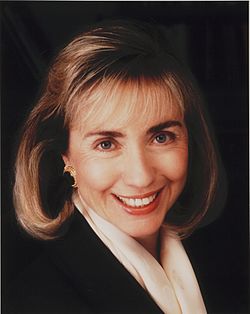
Hillary Clinton’s official portrait as First Lady, 1994
When Bill Clinton took office as president in January 1993, Hillary Rodham Clinton became the first lady. Her press secretary reiterated she would be using that form of her name.[e] She was the first in this role to have a postgraduate degree and her own professional career up to the time of entering the White House.[135] She was also the first to have an office in the West Wing of the White House in addition to the usual first lady offices in the East Wing.[59][136] During the presidential transition, she was part of the innermost circle vetting appointments to the new administration. Her choices filled at least eleven top-level positions and dozens more lower-level ones.[137][138] After Eleanor Roosevelt, Clinton was regarded as the most openly empowered presidential wife in American history.[139][140]
Some critics called it inappropriate for the first lady to play a central role in public policy matters. Supporters pointed out that Clinton’s role in policy was no different from that of other White House advisors, and that voters had been well aware she would play an active role in her husband’s presidency.[141]








Reviews
There are no reviews yet.